Add a solver to generate solutions to a project prioritization problem with the SYMPHONY software. This function can also be used to customize the behavior of the solver. It requires the lpsymphony package to be installed.
Usage
add_lpsymphony_solver(
  x,
  gap = 0,
  time_limit = .Machine$integer.max,
  first_feasible = FALSE,
  verbose = TRUE
)
Arguments
- x
problem()ormulti_problem()object.- gap
numericgap to optimality. This gap is relative and expresses the acceptable deviance from the optimal objective. For example, a value of 0.01 will result in the solver stopping when it has found a solution within 1% of optimality. Additionally, a value of 0 will result in the solver stopping when it has found an optimal solution. The default value is 0 (i.e., 0% from optimality).- time_limit
numerictime limit in seconds to run the optimizer. The solver will return the current best solution when this time limit is exceeded.- first_feasible
logicalshould the first feasible solution be be returned? Iffirst_feasibleis set toTRUE, the solver will return the first solution it encounters that meets all the constraints, regardless of solution quality. Note that the first feasible solution is not an arbitrary solution, rather it is derived from the relaxed solution, and is therefore often reasonably close to optimality. Defaults toFALSE.- verbose
logicalshould information be printed during optimization? Defaults toTRUE.
Value
A problem() object with the solver added to it.
Details
SYMPHONY is an open-source integer programming solver that is part of the Computational Infrastructure for Operations Research (COIN-OR) project, an initiative to promote development of open-source tools for operations research (a field that includes linear programming). The lpsymphony package is distributed through Bioconductor. This functionality is provided because the lpsymphony package may be easier to install to install on Windows and Mac OSX systems than the Rsymphony package.
Examples
# load data
data(sim_projects, sim_features, sim_actions)

# build problem with lpsymphony solver
p <-
  problem(
    sim_projects, sim_actions, sim_features,
    "name", "success", "name", "cost", "name"
  ) %>%
  add_max_wtd_sum_objective(budget = 200) %>%
  add_binary_decisions() %>%
  add_lpsymphony_solver()

# print problem
print(p)
#> Project Prioritization Problem
#> actions:         F1_action, F2_action, F3_action, ... (6 actions)
#> projects:        F1_project, F2_project, F3_project, ... (6 projects)
#> features:        F1, F2, F3, ... (5 features)
#> action costs:    continuous values (between 0 and 103.226)
#> project success: proportion values (between 0.814 and 1)
#> objective:       maximum weighted sum objective
#> targets:         none specified
#> weights:         none specified
#> constraints:     none specified
#> decisions:       binary decision
#> solver:          lpsymphony solver

# solve problem
s <- solve(p)

# print solution
print(s)
#> # A tibble: 1 × 21
#>   solution status   cost   obj F1_action F2_action F3_action F4_action F5_action
#>      <int> <chr>   <dbl> <dbl> <lgl>     <lgl>     <lgl>     <lgl>     <lgl>
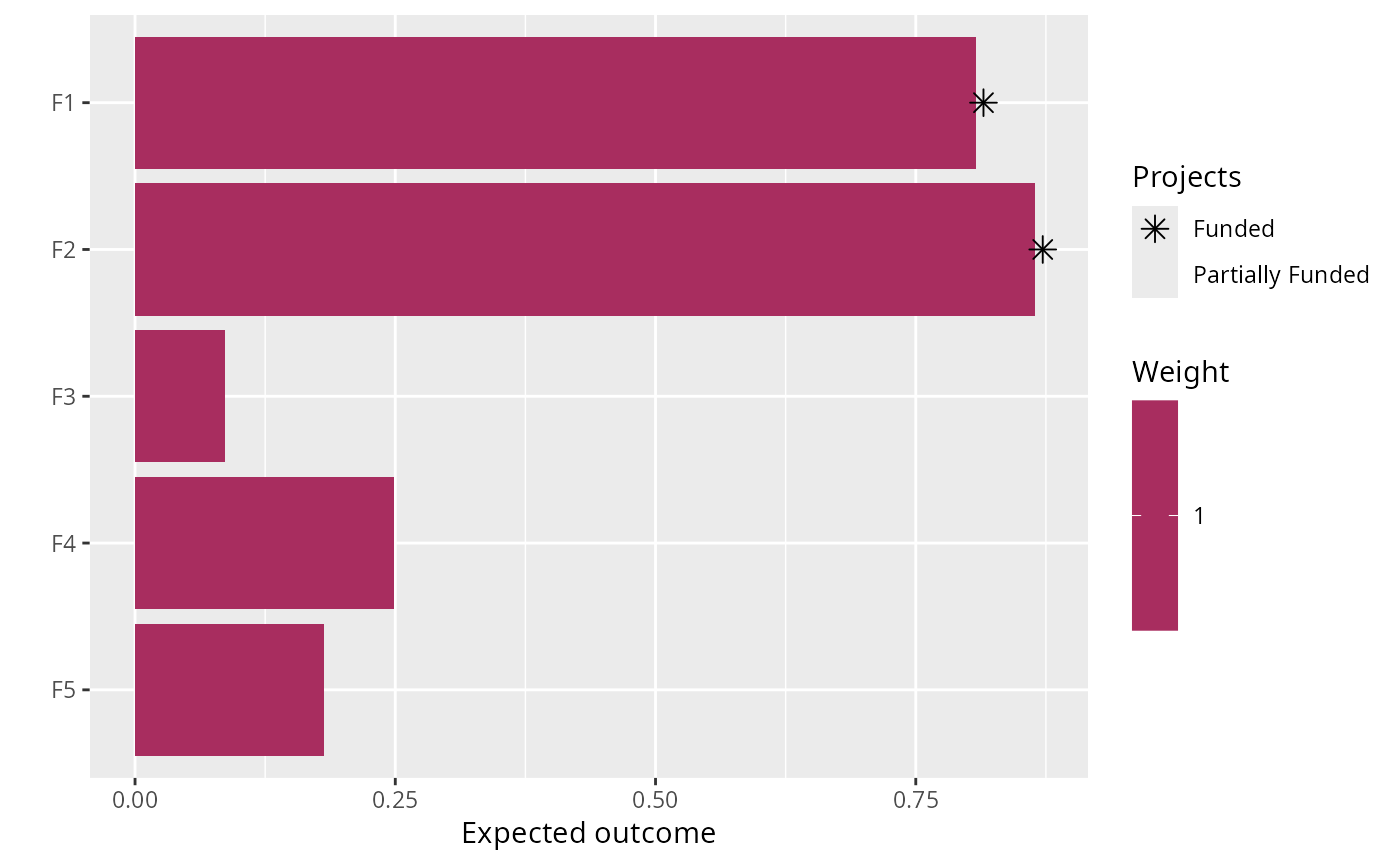
#> 1        1 TM_OPT…  195.  2.19 TRUE      TRUE      FALSE     FALSE     FALSE
#> # ℹ 12 more variables: baseline_action <lgl>, F1_project <lgl>,
#> #   F2_project <lgl>, F3_project <lgl>, F4_project <lgl>, F5_project <lgl>,
#> #   baseline_project <lgl>, F1 <dbl>, F2 <dbl>, F3 <dbl>, F4 <dbl>, F5 <dbl>

# plot solution
plot(p, s)